




'/%3e%3c/g%3e%3cdefs%3e%3clinearGradient%20id='paint0_linear_0_63'%20x1='66.6549'%20y1='164.256'%20x2='120.664'%20y2='26.289'%20gradientUnits='userSpaceOnUse'%3e%3cstop%20stop-color='%23A97DFF'/%3e%3cstop%20offset='1'%20stop-color='%237E47D1'/%3e%3c/linearGradient%3e%3c/defs%3e%3c/svg%3e)


'%3e%3crect%20width='190.586'%20height='190.586'%20rx='95.2928'%20fill='%23FBE8FA'/%3e%3cg%20id='Ellipse%2023'%20filter='url(%23filter0_f_0_4)'%3e%3cellipse%20cx='4.62548'%20cy='137.851'%20rx='123.973'%20ry='127.674'%20fill='%23FD91E4'/%3e%3c/g%3e%3cg%20id='Group%20895'%3e%3cpath%20id='Vector'%20opacity='0.5'%20d='M95.7556%20190.586C148.384%20190.586%20191.048%20147.922%20191.048%2095.2928C191.048%2042.664%20148.384%200%2095.7556%200C43.1268%200%200.462769%2042.664%200.462769%2095.2928C0.462769%20147.922%2043.1268%20190.586%2095.7556%20190.586Z'%20fill='white'/%3e%3cpath%20id='Vector_2'%20d='M94.3669%20169.307C135.499%20169.307%20168.843%20136.17%20168.843%2095.2928C168.843%2054.4161%20135.499%2021.279%2094.3669%2021.279C53.2347%2021.279%2019.8905%2054.4161%2019.8905%2095.2928C19.8905%20136.17%2053.2347%20169.307%2094.3669%20169.307Z'%20fill='url(%23paint0_linear_0_4)'/%3e%3c/g%3e%3c/g%3e%3c/g%3e%3cdefs%3e%3cfilter%20id='filter0_f_0_4'%20x='-406.054'%20y='-276.53'%20width='821.359'%20height='828.76'%20filterUnits='userSpaceOnUse'%20color-interpolation-filters='sRGB'%3e%3cfeFlood%20flood-opacity='0'%20result='BackgroundImageFix'/%3e%3cfeBlend%20mode='normal'%20in='SourceGraphic'%20in2='BackgroundImageFix'%20result='shape'/%3e%3cfeGaussianBlur%20stdDeviation='143.353'%20result='effect1_foregroundBlur_0_4'/%3e%3c/filter%3e%3clinearGradient%20id='paint0_linear_0_4'%20x1='67.1177'%20y1='164.256'%20x2='121.127'%20y2='26.289'%20gradientUnits='userSpaceOnUse'%3e%3cstop%20stop-color='%23A97DFF'/%3e%3cstop%20offset='1'%20stop-color='%237E47D1'/%3e%3c/linearGradient%3e%3cclipPath%20id='clip0_0_4'%3e%3crect%20width='190.586'%20height='190.586'%20rx='95.2928'%20fill='white'/%3e%3c/clipPath%3e%3c/defs%3e%3c/svg%3e)
Introduction
Teams rarely burn out overnight. People keep showing up to meetings, answering messages in work chats, and closing out tasks. But initiative starts to fade, mistakes pile up, and an ordinary conversation about workload increasingly ends with the same words: "I'm just tired."
On its own, none of these signals proves anything. Together, they can mean the work environment is draining people faster than they can recover.
Companies often notice burnout only after productivity has already dropped, sick leave has increased, or a strong performer decides to quit. That's why employee mental health isn't an extra activity for Wellbeing Day. It's one of the factors behind sustainable team performance, retention, and operational stability.
The World Health Organization estimates that depression and anxiety disorders cost the world around 12 billion working days and roughly $1 trillion in lost productivity every year. At the same time, WHO stresses that employers can influence the situation through changes to working conditions, manager training, access to support, and reasonable adjustments to how work is organized around people's needs. Source: WHO.
12 billion
workdays lost every year

≈ $1 trillion
in lost productivity
What HR Needs to Do: The Short Answer
A mental health support system works when a company knows how to see, support, and act:
- See: regularly tracks trends and identifies psychosocial risks at the team level, without trying to diagnose individuals.
- Support: gives employees confidential access to personalized self-support and a clear path to professional help.
- Act: turns aggregated signals into priorities for HR and leaders — from reviewing workloads to training managers.
- Measure results: tracks changes in people's wellbeing and team performance after specific decisions.

Mental Health Support System

A single webinar can deliver useful knowledge. A single consultation can help one specific person. But systemic results only appear when personal support, work processes, management, and analytics operate as a single loop.
What Mental Health at Work Actually Means
Mental health at work isn't a state of constant calm or high motivation. A person can feel anxious before a presentation, tired after a hard week, or worried about something happening outside of work. That's a normal part of life.
What matters for a company is something else: whether an employee can recover, do their job, work with others, make decisions, and ask for help when their own resources run low. This isn't about constant peak performance — it's about a team's ability to work steadily without systemic burnout.
An employer doesn't control everything that affects a person's wellbeing. But it is responsible for what happens inside the work itself:
- how realistic workloads are;
- how clear roles and priorities are;
- manager behavior;
- attitudes toward mistakes and feedback;
- rules for communication outside work hours;
- how it responds to discrimination, harassment, and conflict;
- availability of support;
- safe return after extended absence.
WHO lists among psychosocial risks: excessive workloads, understaffing, long or inflexible hours, low control over one's work, authoritarian supervision, unclear roles, discrimination, violence, and conflict between work and personal life. In other words, the problem can't simply be pinned on an employee's ability to "cope better with stress."
Why This Is a Business Issue, Not Just a Personal One
A decline in mental health doesn't always look like sick leave or a resignation letter. Often a person keeps working, but finds it harder to concentrate, prioritize, communicate with colleagues, and recover after periods of high workload.
A company can see the consequences show up in the work itself:
- deadlines slip more often;
- mistakes and rework increase;
- people propose new solutions less often;
- tension and conflict rise within teams;
- employees take more unplanned days off;
- strong performers disengage or start looking for another job;
- managers spend more and more time firefighting.
These signs don't confirm depression, an anxiety disorder, or burnout in any specific person. They can also be driven by strategy shifts, weak processes, skill gaps, or personal circumstances. HR's job isn't to guess a diagnosis — it's to spot recurring problems earlier, set priorities for action, and check what in the work system is making them worse.
These signs don't confirm a diagnosis
How to Spot the Problem Before It Becomes a Crisis
An annual survey captures a team's state on one specific day. If workload shifts sharply afterward, a new manager arrives, or a reorganization begins, the results go stale fast.
A more reliable picture is built from several sources:
Short regular check-ins
One or a few simple questions help track trends: whether people are recovering, how mood is shifting, and whether they link tension to work. What matters isn't any single answer, but the trend over several weeks.
Periodic validated questionnaires
Scientifically validated scales can help screen for symptoms and track changes over time. Screening is not a diagnosis. Its results should guide a person toward the right level of support, not become material for evaluating their job performance.
Operational metrics
It's useful to look at turnover, sick leave, unplanned absences, overtime, mistakes, conflicts, and engagement survey results. These data points are best analyzed together, rather than searching for a single "magic" metric.
Team context
The same metric can have different causes. A dip in energy after a seasonal peak is different from prolonged exhaustion due to understaffing. Data shows where to ask questions. Conversations with employees and an analysis of work processes help explain the actual cause.
This approach gives HR not a list of "problem people," but a map of areas that need attention. It shows where a team is losing resources and where limited resources should go first. A modern HR tech platform for mental health should surface team-level dynamics — not employees' individual answers.
How to Measure Team Wellbeing Without Compromising Privacy
Employees won't answer honestly if they suspect their manager will see their name, scores, or the content of personal conversations. Without trust, a company ends up with a tidy report that doesn't reflect reality.
Health data falls under a special category of particularly sensitive personal data under Article 9 of the GDPR. That means confidentiality can't just be a promise in an email from HR — it has to be built into the process and the technology.
Before launching a program, give employees clear answers to seven questions:
- What data does the system collect?
- Why is it collected?
- Who sees individual responses?
- What exactly do HR and managers see?
- Will answers affect performance reviews, compensation, or career progression?
- How long will the data be stored?
- How can a person withdraw consent or delete their data?
Management decisions usually only need aggregated trends: for example, which department shows rising burnout risk, or where employees more often link stress to workload. Individual responses should never become a way to monitor a specific person.
For small teams, set a minimum threshold before showing results, and aggregate data over a longer period. Otherwise, even a report without names can indirectly point to a specific employee.
Scarb — our team's product — brings together two layers that usually exist separately. Employees get a confidential space to assess their state and access personalized self-support. The company sees aggregated, anonymized signals at the team and department level — not individual answers, diagnoses, or conversations. This lets HR respond to a trend without intruding on anyone's private life.
Employee
%201'%3e%3cpath%20id='Vector'%20d='M10%2036.6667C9.08333%2036.6667%208.29861%2036.3403%207.64583%2035.6875C6.99306%2035.0347%206.66667%2034.25%206.66667%2033.3333V16.6667C6.66667%2015.75%206.99306%2014.9653%207.64583%2014.3125C8.29861%2013.6597%209.08333%2013.3333%2010%2013.3333H11.6667V10C11.6667%207.69444%2012.4792%205.72917%2014.1042%204.10417C15.7292%202.47917%2017.6944%201.66667%2020%201.66667C22.3056%201.66667%2024.2708%202.47917%2025.8958%204.10417C27.5208%205.72917%2028.3333%207.69444%2028.3333%2010V13.3333H30C30.9167%2013.3333%2031.7014%2013.6597%2032.3542%2014.3125C33.0069%2014.9653%2033.3333%2015.75%2033.3333%2016.6667V33.3333C33.3333%2034.25%2033.0069%2035.0347%2032.3542%2035.6875C31.7014%2036.3403%2030.9167%2036.6667%2030%2036.6667H10ZM10%2033.3333H30V16.6667H10V33.3333ZM22.3542%2027.3542C23.0069%2026.7014%2023.3333%2025.9167%2023.3333%2025C23.3333%2024.0833%2023.0069%2023.2986%2022.3542%2022.6458C21.7014%2021.9931%2020.9167%2021.6667%2020%2021.6667C19.0833%2021.6667%2018.2986%2021.9931%2017.6458%2022.6458C16.9931%2023.2986%2016.6667%2024.0833%2016.6667%2025C16.6667%2025.9167%2016.9931%2026.7014%2017.6458%2027.3542C18.2986%2028.0069%2019.0833%2028.3333%2020%2028.3333C20.9167%2028.3333%2021.7014%2028.0069%2022.3542%2027.3542ZM15%2013.3333H25V10C25%208.61111%2024.5139%207.43056%2023.5417%206.45833C22.5694%205.48611%2021.3889%205%2020%205C18.6111%205%2017.4306%205.48611%2016.4583%206.45833C15.4861%207.43056%2015%208.61111%2015%2010V13.3333Z'%20fill='%237153FF'/%3e%3c/g%3e%3c/svg%3e)
Encryption, anonymization, and data aggregation
HR and managers
What an Employee Psychological Support System Consists Of
WHO recommends combining organizational change, training for managers and employees, individual tools, reasonable adjustments to work, and return-to-work programs. In practice, this can be organized into four levels. They don't replace one another: a company simultaneously reduces systemic risks, provides accessible support, and ensures a path to professional help.
Level 1. Reduce Risks in the Work Itself
Start with the causes a company can actually influence:
- review workloads and team headcount;
- agree on rules for messages outside working hours;
- make roles, priorities, and success criteria clear;
- give employees more control over how they do their work wherever possible;
- create a procedure for responding to bullying, discrimination, and harassment;
- plan support for reorganizations, layoffs, and employees returning after military service or extended leave.
If a team is systematically working 12-hour days, a breathing exercise won't fix the root cause of burnout. Self-help tools are useful, but they shouldn't mask poorly organized work.
Level 2. Train Managers to Respond the Right Way
A manager is usually the first person to notice changes in someone's work. What they need isn't therapist skills, but a simple protocol:
- describe a specific observation without judgment;
- ask what's making work harder right now;
- listen without diagnosing;
- discuss changes to workload, deadlines, or how the team works together;
- point to available support resources;
- agree on a follow-up;
- follow the crisis protocol if there's an immediate safety risk.
For example: "Over the last two weeks, three deadlines had to be pushed back, which hasn't happened before. I want to understand if there's something in the work that's getting in your way right now, and what we can change."
That's better than: "I think you're burned out."
Level 3. Give Employees Accessible Everyday Support
Not everyone needs therapy right away. For some, it helps to better understand their own state, track recurring triggers, do a short exercise, build better recovery habits, or prepare to seek professional help.
So the baseline level of support can include:
- short state check-ins;
- personalized self-support programs;
- stress-regulation exercises;
- a mood and emotions journal;
- short educational content;
- a clear path to a specialist when self-help isn't enough.
These tools need to be available when a person actually needs them, not just on the day of a corporate lecture. The same library of materials for everyone doesn't account for different states and needs, so support should adapt to each person's own dynamics.
Level 4. Ensure Access to Professional and Crisis Support
A company should define in advance where an employee can turn for professional help and what to do in a crisis. This can include external psychologists, psychotherapists, medical professionals, an insurance program, or vetted specialized services.
It's important to clearly separate roles. HR organizes the system. The manager supports the person within the work context. A qualified specialist assesses their condition and provides professional care.
What a Manager Can and Cannot Do
A manager can:
- talk about noticeable changes in someone's work;
- ask what support is needed within the scope of the work process;
- review workload, priorities, deadlines, and schedule;
- maintain regular contact;
- point the person to available resources;
- follow the approved crisis protocol.
A manager should not:
- make a diagnosis;
- demand details about personal circumstances;
- pressure someone into therapy or program participation;
- ask to see test results or the content of conversations with a psychologist;
- promise something the company can't deliver;
- use information about someone's condition in HR decisions unrelated to safety.
The key boundary is simple: a manager works with the conditions of the job, not with treating the person.
How to Launch a Program: A 90-Day Plan
Ukraine's Ministry of Economy recommends starting with a working group and a situation analysis, then building a policy, assessing needs, drafting a plan, and defining resources and a monitoring system. Ukraine's Ministry of Economy guidance for employers.
Here's what that process can look like inside a company.
Days 1–30: Understand the Starting Point
- Appoint a responsible leader and a working group.
- Define why the company needs the program and what problem it should solve.
- Review existing policies, benefits, insurance, and available resources.
- Conduct an anonymous baseline assessment.
- Agree on rules for confidentiality and data access.
- Decide which metrics you'll record before launch.
The output of this stage isn't a big presentation — it's a short map: where the risks are, what's already working, and what's missing.
Days 31–60: Build the Program
- Pick two or three priority problems.
- For each one, define an organizational action and an employee support tool.
- Prepare managers for conversations with their teams.
- Document the path to professional and crisis help.
- Explain to employees which data the company sees and which stays private.
- Select a group for the pilot.
For example, if burnout is rising in one department, the answer isn't necessarily another lecture about stress. First, check workload, scheduling, headcount, how tasks are assigned, and whether there's room to recover.
Days 61–90: Launch the Pilot and Adjust the System
- Launch the program in the selected teams.
- Track engagement without pressuring employees.
- Gather short feedback on ease of use and trust.
- Compare changes in wellbeing against the baseline.
- Record which management decisions managers made.
- After 30 days, assess what changed following specific management and HR decisions, drop what people aren't using, and reinforce what's working.
The pilot isn't there to produce a nice report. It should show whether people actually use the support, whether they trust the system, whether the company can turn data into action, and whether the situation changed after that action.
Baseline → Pilot → Action → Measure → Adjust / Scale
Which Metrics Are Worth Tracking
It's useful to split metrics into three groups.
Engagement.
- share of employees who activated access;
- share who completed the baseline assessment;
- check-in frequency;
- use of materials, exercises, and other support formats;
- return usage over time.
Changes in team wellbeing.
- trends in mood and wellbeing;
- changes in stress, anxiety, and burnout indicators;
- share of teams with elevated risk;
- time from detecting a trend to taking action;
- change in outcomes after a specific action.
Business and work processes.
- unplanned absences and sick leave;
- turnover and intent to leave;
- overtime;
- engagement and sense of support;
- HR time spent on surveys, analysis, and reporting;
- time from signal appearing to a management decision;
- number of management actions taken after identified risks.
Not every change can be attributed to a mental health program. Turnover, productivity, and absences are affected by dozens of factors. So establish a baseline, track trends over time, compare similar periods, and record exactly which actions were implemented.
Seven Mistakes That Make Programs Fail
The Company Starts With Content, Not Needs
HR orders a series of lectures before figuring out what's actually happening in teams. The topics might be useful, but they don't address the real risks.
Responsibility Gets Shifted to the Employee
People are taught to breathe and meditate, while chronic overwork, conflicting priorities, or a manager's toxic behavior go unchanged.
Managers Are Turned Into Psychologists
Without clear boundaries, managers either avoid these conversations altogether or start giving advice they aren't trained to give.
Confidentiality Isn't Explained Clearly
Saying "it's all anonymous" isn't enough. Employees need to understand exactly what data the employer sees, and whether they could still be identified in a small team.
Surveys Run, But Results Never Turn Into Action
After a few cycles like this, people stop answering honestly. Analytics only makes sense when it helps identify a priority, an owner, and a next step. Feedback should end in an action — or a clear explanation of why action isn't possible right now.
Success Is Measured by Activity Count
Ten webinars don't mean a team's wellbeing has improved. The number of activities describes HR's effort, not its outcome.
The Program Launches Company-Wide From Day One
Without a pilot, it's harder to spot communication mistakes, technical barriers, and the reasons behind low engagement. A small-scale launch lets you fix these before scaling up.
Checklist for HR and Leadership
A program has a solid foundation if you can answer "yes" to these questions:
- We know which psychosocial risks matter most for different teams right now.
- Employees understand what data is collected and who sees it.
- Individual responses are never used to evaluate job performance.
- Managers know how to start a supportive conversation and where their role ends.
- Employees have access to both daily self-support and professional help.
- We're changing not just people's behavior, but the conditions of work.
- Baseline metrics were recorded before launch.
- Every identified risk has an owner and a next action.
- HR and leaders see priorities instead of spending time manually compiling scattered signals.
- We evaluate changes in trends, not a single survey.
- The program goes through regular review.
'%20d='M27.3937%2016.2333C27.3937%2010.0696%2022.397%205.0729%2016.2333%205.0729C10.0696%205.0729%205.0729%2010.0696%205.0729%2016.2333C5.0729%2022.397%2010.0696%2027.3937%2016.2333%2027.3937C22.397%2027.3937%2027.3937%2022.397%2027.3937%2016.2333ZM16.2438%2020.2916C16.804%2020.2918%2017.2584%2020.746%2017.2584%2021.3062V21.3167C17.2582%2021.8767%2016.8038%2022.3311%2016.2438%2022.3313H16.2333C15.6731%2022.3313%2015.2189%2021.8769%2015.2187%2021.3167V21.3062C15.2187%2020.7458%2015.6729%2020.2916%2016.2333%2020.2916H16.2438ZM15.2187%2017.2479V12.175C15.2187%2011.6146%2015.6729%2011.1604%2016.2333%2011.1604C16.7936%2011.1604%2017.2479%2011.6146%2017.2479%2012.175V17.2479C17.2479%2017.8082%2016.7936%2018.2624%2016.2333%2018.2624C15.6729%2018.2624%2015.2187%2017.8082%2015.2187%2017.2479ZM29.4228%2016.2333C29.4228%2023.5177%2023.5177%2029.4228%2016.2333%2029.4228C8.9489%2029.4228%203.04374%2023.5177%203.04374%2016.2333C3.04374%208.9489%208.9489%203.04374%2016.2333%203.04374C23.5177%203.04374%2029.4228%208.9489%2029.4228%2016.2333Z'%20fill='%237153FF'/%3e%3c/g%3e%3c/svg%3e)
If the answer to most of these is "no," the company doesn't need another activity. It needs a system.
Sources
- Mental health at work — World Health Organization
- WHO guidelines on mental health at work
- Mental health at work: WHO/ILO policy brief
- Guidelines on psychosocial support in the workplace — Ministry of Economy of Ukraine
- General Data Protection Regulation — EUR-Lex
How Scarb Helps Sustain Team Performance
Scarb is an HR tech platform for sustainable team performance. It brings together what exists separately at many companies: confidential, personalized employee support and aggregated analytics for HR and leaders.
Employees can regularly assess their state, track their own trends, and receive relevant tasks, short practices, microlearning, a journal, and other self-support tools. When needed, a person gets a clear path to additional help. Scarb doesn't make medical diagnoses and doesn't replace a psychologist, psychotherapist, or medical care.
HR and leaders get an aggregated view across teams and departments: where stress and burnout are building up, which areas need attention first, and how the situation changes after decisions are made. This means resources go where they're needed most, instead of HR manually piecing signals together.
As a result, people get support, HR gets clarity and priorities, and the business gets more resilient teams and fewer hidden losses. The company doesn't control employees' personal lives — it sees risks earlier, takes relevant action, and measures the results.
Want to see where your teams are losing resources and how to turn those signals into a concrete action plan? Request a Scarb demo.
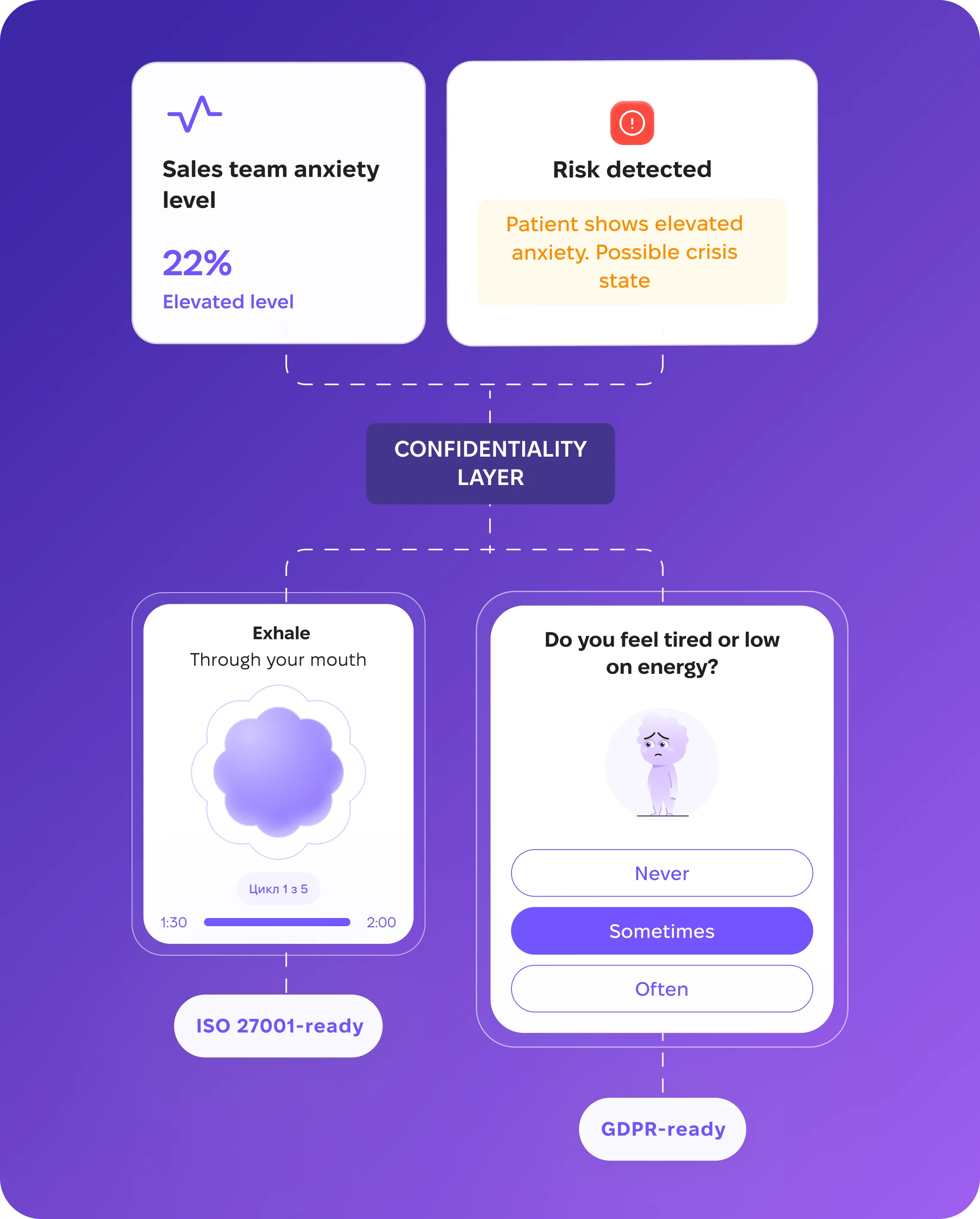
Personal support for the individual. Aggregated analytics for the company.
